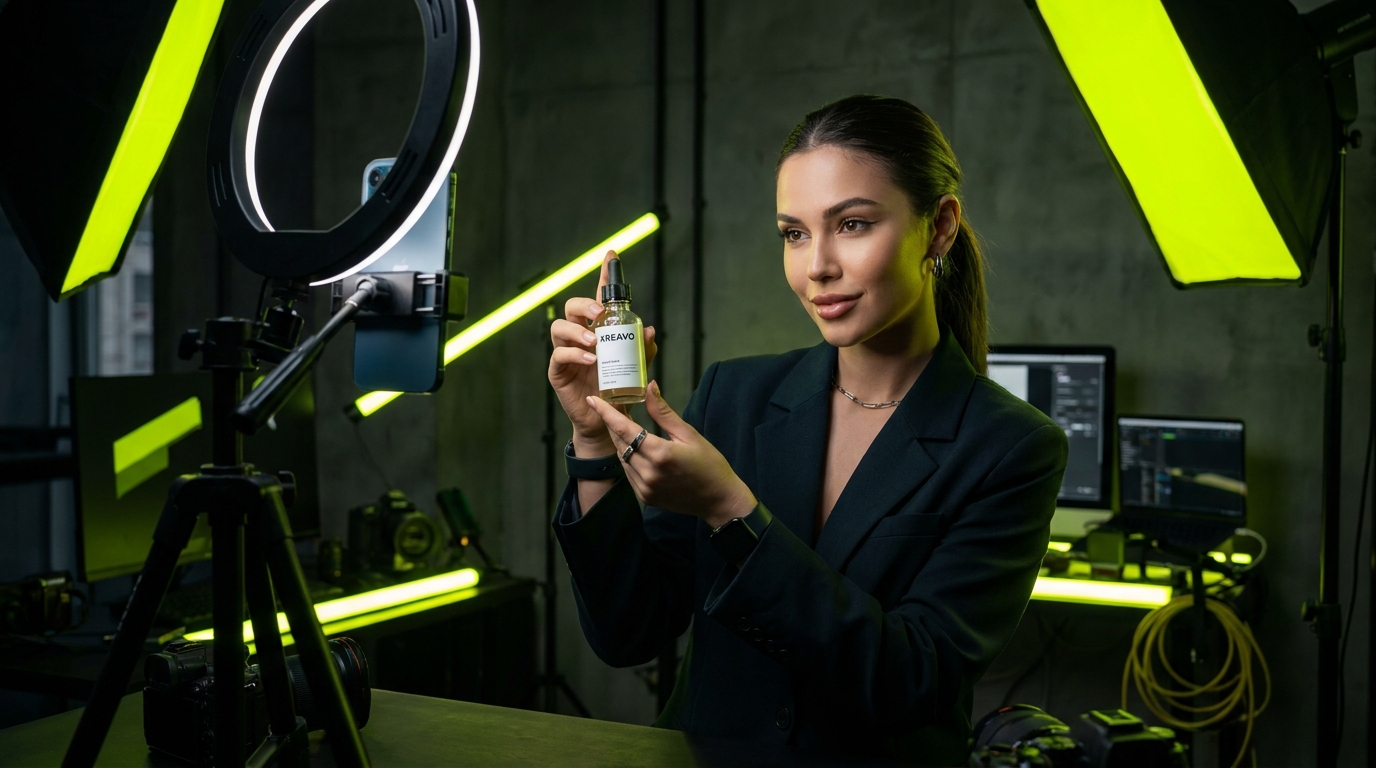
The first two seconds of a UGC ad decide whether anyone sees the rest of it, which is why the hook matters more than the product shot, the offer, or the music. This playbook gives you ten UGC hook patterns with one example line each, a 15 to 30 second script skeleton, and a way to generate variants with AI UGC instead of re-filming.
What makes a UGC hook work
A hook works when it opens a loop the viewer wants closed: a problem they recognize, a claim they doubt, or a situation they are in right now. Good UGC hooks are first-person, plain, and specific enough that a stranger could picture the scene. Vague hooks ("this changed my life") get skipped; concrete hooks ("I stopped buying paper towels three months ago") get watched.
- Speak to one person, not to an audience.
- Lead with the problem or the surprising outcome, never with the brand name.
- Put the hook in the captions too, since most feeds start muted.
- Match the hook to the visual: if the line mentions the product, the product should be in frame.
10 UGC video hook patterns with examples
Each pattern below can be adapted to almost any physical product or app. The example lines are deliberately generic so you can swap in your own product, problem, and audience.
- Problem-solution: "My desk cables were a mess every single morning until I tried this." Name the pain, then show the fix in the same breath.
- POV: "POV: you finally found a water bottle that fits your car's cup holder." Puts the viewer inside a situation they already know.
- "I was skeptical": "I was sure this was another gimmick. Here's what happened after two weeks." Pre-empts doubt by voicing it first.
- Unboxing: "Okay, it just arrived. Let's see if it's as small as they say." Curiosity plus a built-in reveal.
- Three reasons: "Three reasons I switched to this and won't go back." A list promise keeps people watching to the end.
- Before/after routine: "Here's my morning routine before this, and here's what it looks like now." Show the change in habits and time, not medical or health outcomes.
- Comparison: "I've used the popular one and this one for a month. Here's the honest difference." Sets up a fair test, not a takedown.
- FAQ-style: "Everyone keeps asking me if this actually fits a laptop. Let me show you." Answers the objection your comments already contain.
- Day-in-the-life: "Come run errands with me and see how many times I use this thing." Repeated natural usage does the selling.
- Mistake to avoid: "If you're buying one of these, don't make the mistake I made." Fear of a wrong purchase is a strong reason to keep watching.
A 15 to 30 second UGC script skeleton
Most winning UGC ads follow the same four-part structure. Time each part, write it out, and you will have a script you can hand to a human creator or feed into an AI UGC generator.
- Hook (0 to 2 seconds): one line from the patterns above, spoken to camera with the product visible or about to appear.
- Context (2 to 8 seconds): who you are and what you were dealing with. One or two sentences, no backstory beyond what makes the problem relatable.
- Demonstration (8 to 22 seconds): show the product in use, doing the specific thing the hook promised. Talk through what you are seeing rather than listing features.
- Close (last 3 to 8 seconds): a plain recommendation plus a low-friction action, such as "link is below" or "check the reviews yourself."
Written out, a 20-second version is roughly 50 to 60 spoken words. If your draft is longer, cut the context first, then the close. Never cut the demonstration; it is the part that converts.
Example UGC ad script (generic product)
Here is the skeleton filled in for a generic kitchen gadget, so you can see the pacing. Replace the nouns and the problem with your own.
- Hook: "I stopped hand-washing my blender every morning because of this."
- Context: "I make a smoothie every day and cleaning the base was the part I hated."
- Demonstration: "You just add water, press this, ten seconds, and it's done. Look at the blades. No scrubbing, no gunk in the corners."
- Close: "If you make anything daily, this is worth it. Link's below if you want the one I use."
How to generate variants with AI UGC
The difference between a good UGC ad and a winning one is usually the number of hooks you tested, not the script. With human creators, each new hook means a new filming session, 3 to 10 days, and $50 to $500 per video. With AI UGC, a video costs $1 to $5 and generates in minutes, so testing ten hooks on one body is routine.
- Pick one AI influencer (ready-made or custom) so the face stays consistent across every variant.
- Upload your real product. It is composited faithfully into the scene, in hand or on a desk, so the demonstration is accurate.
- Write the body once (context, demonstration, close) and keep it fixed.
- Write ten hooks, one per pattern above, and generate ten videos that differ only in the opening line.
- Export in 9:16 for TikTok, Reels, and Shorts, launch all ten in one ad set, and let the platform sort them.
- Take the two or three hooks that outperform and iterate again: new scenes, a second influencer, a 16:9 cut for YouTube or your product page.
Structural changes are just as cheap to test: a 15-second cut versus a 30-second cut, or a lifestyle scene versus a plain desk. Change one variable per round so you learn something each time.
Common mistakes in UGC ad scripts
- Opening with the brand name or logo instead of a hook the viewer cares about.
- Listing features ("stainless steel, BPA-free, 24 oz") instead of showing one moment of use.
- Making promises the video cannot demonstrate on screen.
- Reading a script word for word; the language should sound like a message to a friend.
- Running one version for weeks instead of rotating fresh hooks as performance fades.
- Forgetting captions, which means the hook is invisible to anyone watching muted.