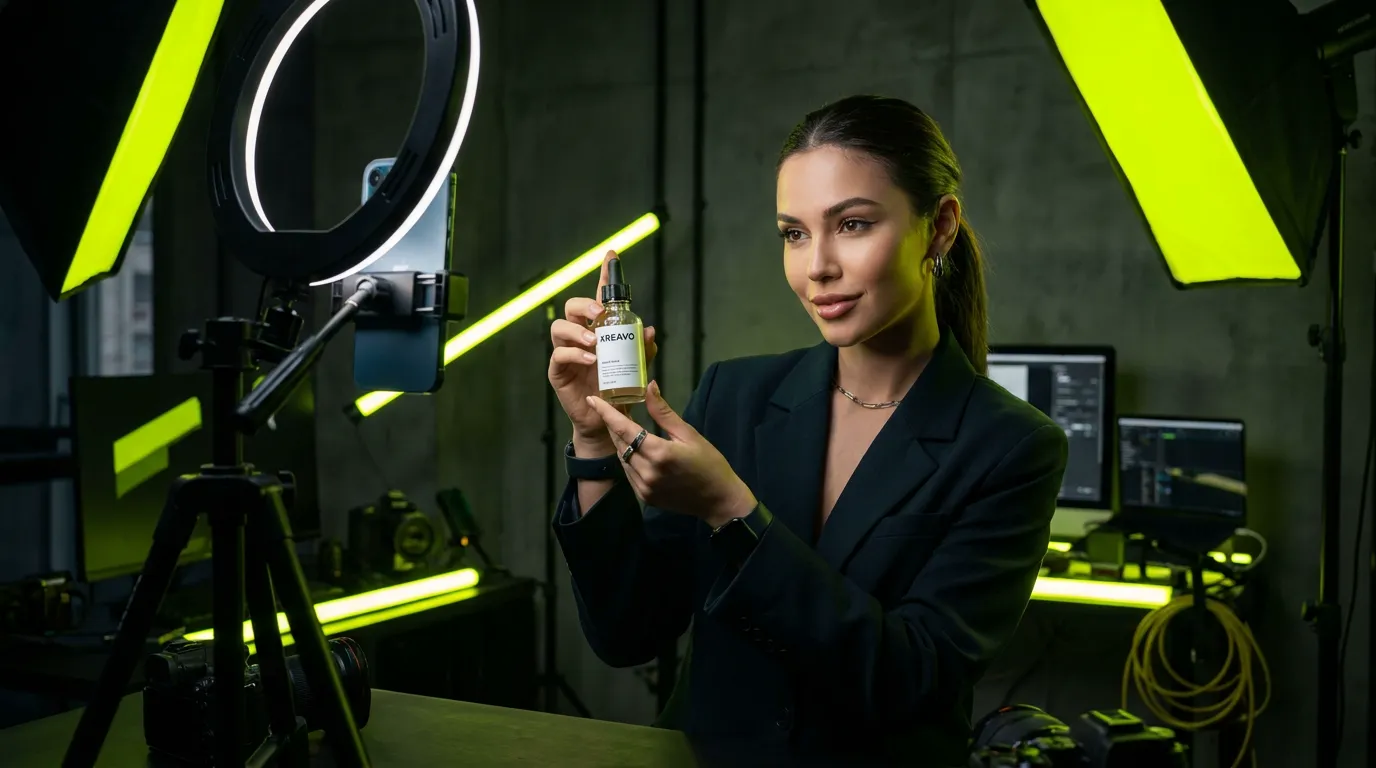
UGC (user-generated content) has become the best-performing ad format in ecommerce: authentic, native to social feeds, and far more credible than a polished commercial. The catch is cost and speed — $50 to $500 per video and 3 to 10 days of turnaround with a human creator. AI UGC fixes both: photorealistic videos generated in minutes, from $1.
What is an AI UGC video?
An AI UGC video is a creator-style video — a person talking to camera, showing or using a product — generated entirely by AI. Instead of hiring a creator, you pick (or create) an AI influencer, add your product and a scene, and the AI produces the video. The result looks like human UGC, without casting or filming.
The key difference from a plain text-to-video clip: AI UGC keeps a consistent character (same face) and composites your real product, which is what makes it usable in ads.
Make an AI UGC video in 4 steps
- Pick or create your AI influencer. Use a ready-made character or generate your own (look, age, vibe). They stay identical across all your videos — essential for a consistent brand.
- Add your product and describe the scene. Upload a product photo and write the scene ("a woman in a bright kitchen presents the product"). The AI keeps your product accurate.
- Write a short, hooky script. 1 hook + 1 benefit + 1 call to action. 15–30 seconds is enough for TikTok, Reels and Shorts.
- Generate, export 9:16, and test. In minutes you get the video. Export vertical and launch it in your campaigns the same day.
The UGC script that converts (structure)
Good UGC follows a simple, ad-proven structure:
- Hook (0–3s): grab attention instantly ("I stopped buying X because of this…").
- Problem (3–8s): name the pain your audience feels.
- Solution (8–20s): show the product in action and the concrete benefit.
- Proof (20–25s): a result, a number, or a believable reaction.
- CTA (25–30s): tell them what to do now ("Link in bio", "20% off today").
How much does an AI UGC video cost?
With Kreavo, an AI UGC video costs $1 to $5 depending on the model. Compare that to the human UGC market: $50 to $500 per video (often $80–$150), plus product shipping and turnaround. On the same testing budget, you go from 2–3 videos to dozens.
- AI UGC: $1–$5 / video, ready in minutes, unlimited revisions.
- Human creator: $50–$500 / video, 3–10 days, paid revisions.
- Typical saving: 10–100× cheaper, with zero logistics.
5 mistakes to avoid
- A weak hook. If the first 3 seconds don't grab, the rest is wasted.
- Switching influencer every video. Consistency (same face) builds brand recognition.
- Videos that are too long. Aim for 15–30s in-feed; keep the pace up.
- Testing only one version. Test volume is your edge — use it.
- Forgetting vertical 9:16. It's the TikTok/Reels/Shorts standard.
Which tool should you use?
For AI UGC, look for: consistent AI influencers (stable face), accurate product compositing, 9:16 export, and a low per-video price so you can test in volume. Kreavo covers all of this from $1 per video, and also includes AI product photography, virtual try-on and TikTok recreation in the same tool.