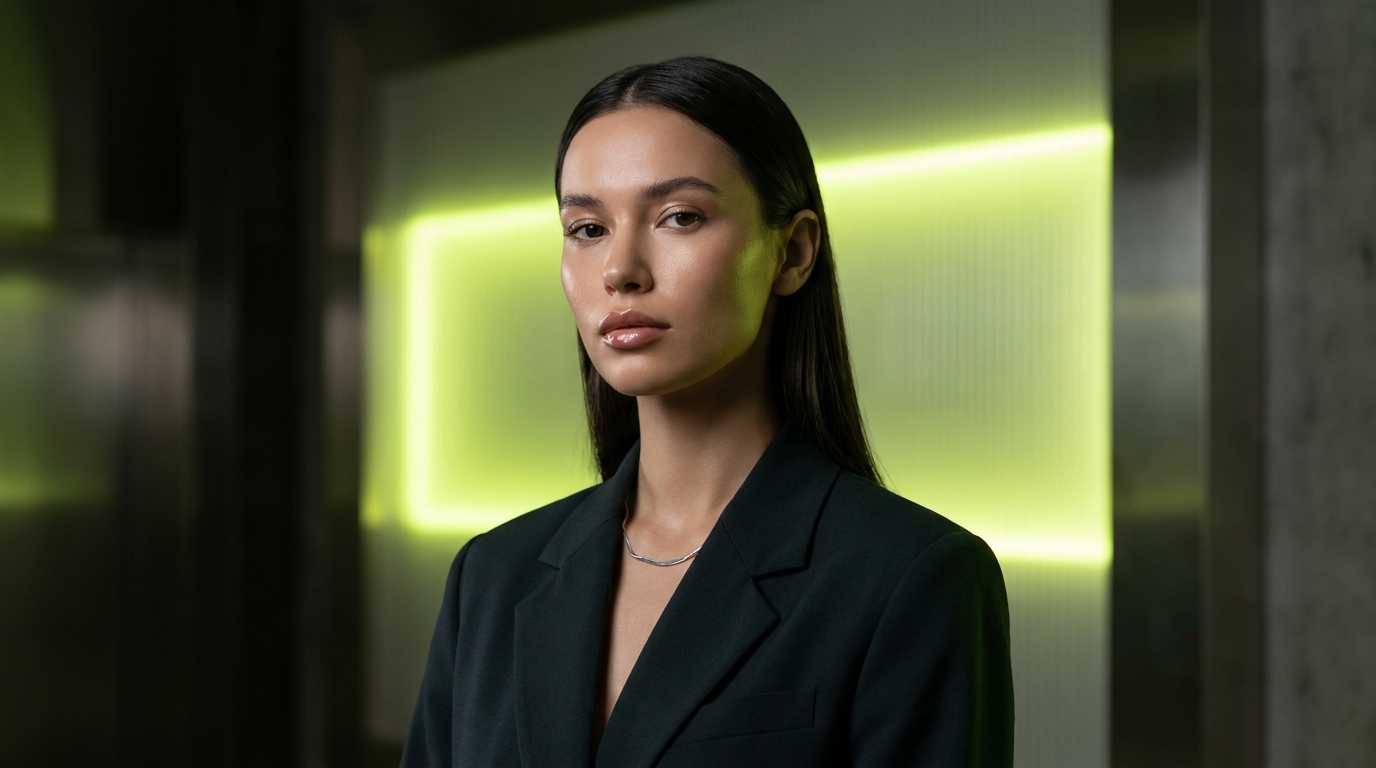
Why faces drift in the first place
If you describe a person in words and ask a video model to generate them, you get a new interpretation every time. "A woman in her thirties with dark curly hair" matches millions of faces, so two prompts produce two people. That is fine for stock-style b-roll and useless for an influencer, whose whole value is being recognizable. Consistency requires that the model be anchored to a specific identity, not to a description.
How character consistency works
- You design the character once: look, age range, style, expression.
- The tool stores that identity as a reference the video and image models are conditioned on.
- Each new generation, whether a 9:16 ad, a product photo, or a try-on, starts from the saved reference rather than from text alone.
- Scene, outfit, product, and camera can change; the face is held.
- The same reference works across the routed models, so you can switch between Seedance, Kling, VEO, or Wan without changing who the presenter is.
This is what a custom AI influencer means on Kreavo: not a saved prompt, but a saved identity that every output is generated from.
Tips for the most consistent results
- Lock the character before you start a campaign; do not tweak the face between batches.
- Keep lighting and camera distance in a realistic range; extreme angles stress any model.
- Change one thing per variation (hook, scene, outfit) so you can see whether the face held.
- Review outputs at full size; small drifts around the jaw or eyes are easiest to catch there.
- If one model drifts on a specific scene, regenerate on another; at $1 to $5 per video, a second pass is cheap.
Beyond video: photos, try-on, face-swap
Consistency is not only for talking-to-camera clips. The same saved influencer can appear in AI product photography from $1 per image up to 4K, model apparel through virtual try-on, or be placed into an existing video through reference-based editing that swaps the person. That lets a brand run one recognizable presenter across ads, product pages, and organic posts, which is the point of having an AI influencer rather than a series of unrelated generated people.